The Drina
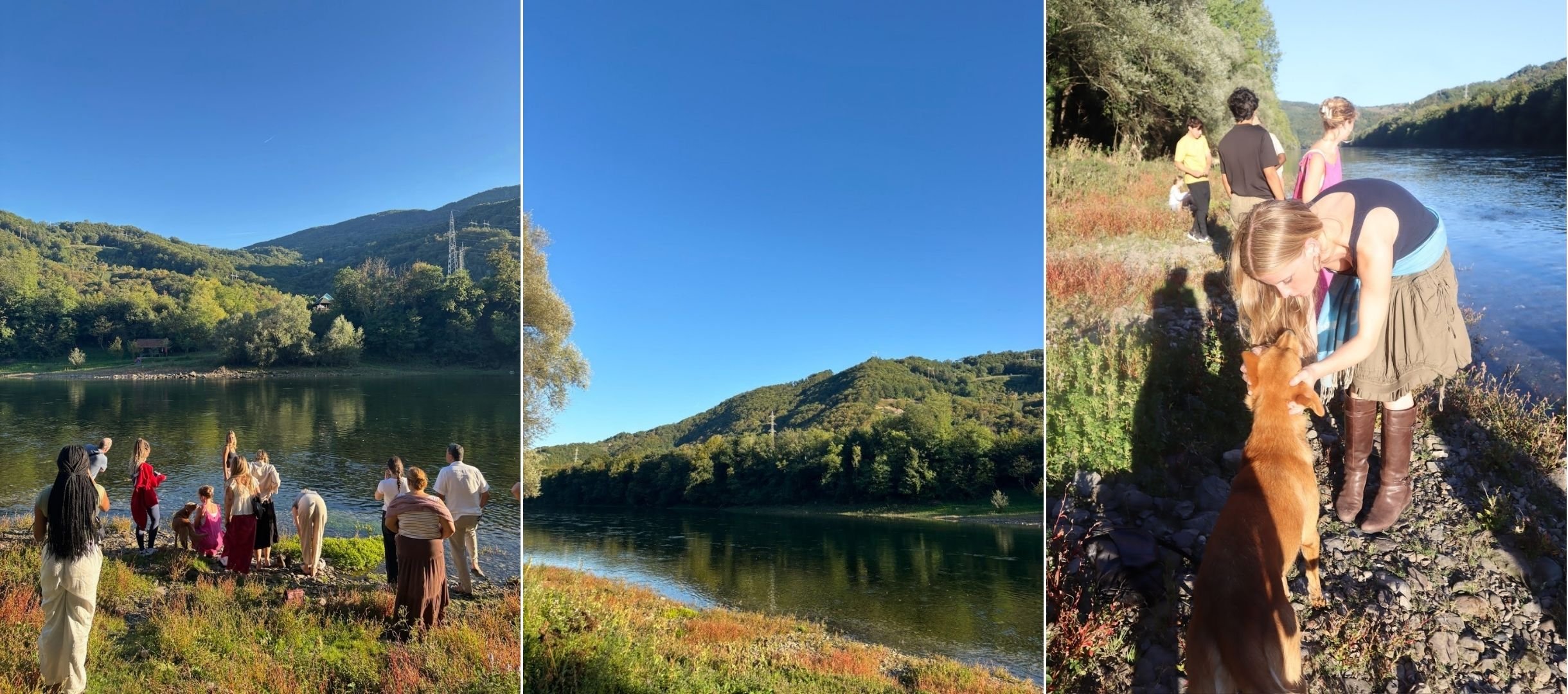
09.22.2025 | 43.956201, 19.502095
People naturally impose their own narratives and perspectives onto, well, everything. There is no objective experience; subjectivity exists alongside all of us.
While studying in Bosnia and Herzegovina, our professors’ leitmotif was that “a narrative told is an imposition of perspective.”
On September 22nd, 2025, my class, our professors, and Hasan Hasanovic took us to the Drina, which marks the western border of Bosnia and Herzegovina and the eastern border of Serbia. We were on our way to Saliha Osmanović’s countryside home.
Ah, the Drina. Imperceptibly changing, tranquil in its endless, patient insistence. Like many rivers, the Drina has borne life and death, unity and division.
As we walked into the Drina’s enclave, its life force felt all-encompassing. We dipped our toes in the cool current, bathed in the evening rays, drank in the autumnal air, and listened to the soft susurrus of birds and insects in the surrounding woods.
Though we were cautioned to be careful. Not to veer too far from the path. Only a day before, we heard stories from Hasan Hasanovic and Nedzad Avdic, both survivors of the Bosnian War and the Siege of Srebrenica. They spoke of the landmines scattered near the border and countryside, still buried somewhere we could not see.
Hasan stood watching us. I could not help but wonder what he saw when he looked at us. Young Americans. Unscarred. A representation of a place untouched by what he had lived through.
And yet, he did not meet us with resentment. Instead, he seemed to draw from something else entirely. From our energy. Our curiosity. Our presence. We were there to listen. To learn. To carry the story forward.
Standing there, it felt like we were not just walking along a river, but through layers of memory. It was disquieting, realizing the world, the river, humanity, persists, despite the violence inflicted upon it.
I began to think about the path. Not only of the physical path we were warned not to stray from, but that of a path shaped by memory. The path shaped by history. By humanity. And then what of the path to come?
The path was not just the strip of gravel we were told not to stray from. It was the narrow space between remembering and continuing to live.
Memories become symbols, and so easily they become burdensome.
The Drina does not choose a narrative. We do. And still, despite everything imposed onto it, people return to its banks to speak, remember, and keep going. A new perception can be imposed. A new narrative can be written.